Web design · WordPress · Kadence · Elementor · Content strategy
Laptop Finder World: Rebuilding a Niche Site After a Lost Domain
After the previous domain lapsed and was bought by someone else, I rebuilt on an aged domain as a laptop-only site — design, structure, review and how-to sections, a laptop finder page and 200+ articles.
Results at a glance
- Platform
- WordPress · Kadence + Elementor
- Scope
- Design, build, content
- Articles
- 200+
- Sections
- Reviews, how-tos, finder
The problem
The previous site was earning affiliate revenue when the domain lapsed. An extended hospital stay meant the renewal was missed, and by the time I was back on my feet the domain had been picked up by someone else. Three years of content, links and rankings went with it.
Losing the domain is not recoverable, so the choice was between starting a new name from zero, or buying an aged domain with existing history and rebuilding on it. I bought an expired domain — Laptop Finder World — and built a laptop-only site on it.
Narrowing to one product category was deliberate. The old site had covered several topics; a single-niche site gives a small publisher a chance to look like a specialist, and it makes internal linking obvious.
Why we decided to solve it
An existing domain with a clean history starts with something a new domain does not: age and prior crawl history. That was worth paying for, but only if the content published on it actually matched the domain’s name and the niche.
The constraint was speed of recovery. Every month offline is revenue and ranking lost, so the plan was to launch a complete site quickly rather than a perfect one slowly, then grow it with content.
How we did it
Design the front page around the buying journey
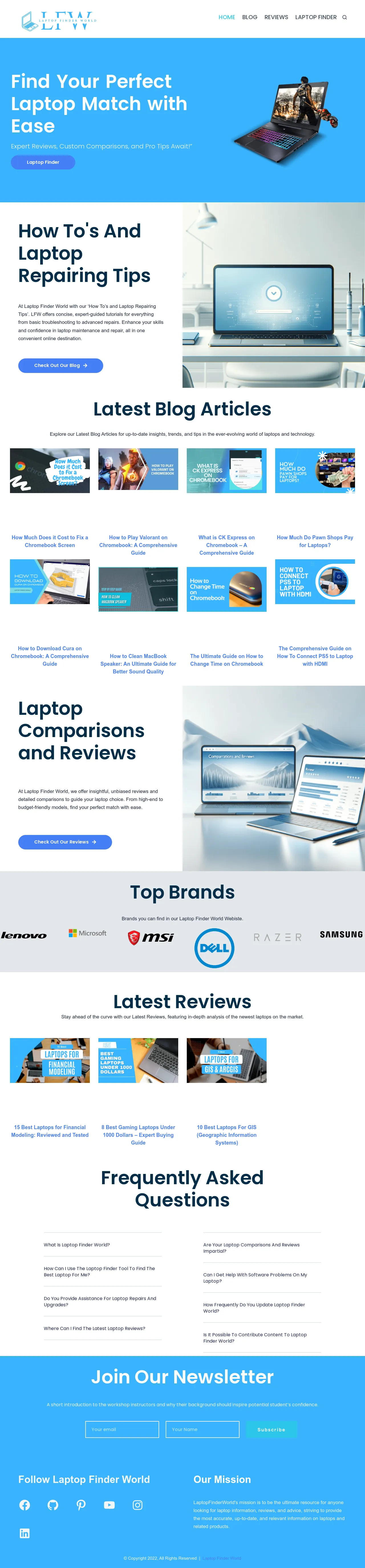
The homepage opens with a promise — “Find your perfect laptop match with ease” — and a single primary action. Underneath, it splits into the two things readers actually arrive for: how-to and repair guidance, and reviews. The article feed sits below that, so the page answers “what is this site” before it lists posts.
Give each content type its own home
Reviews, how-tos and the laptop finder page were structured as separate sections rather than dumped into one blog feed. That gave each type its own navigation, its own template and its own internal linking pattern, and it told a reader what to expect when they landed.
Build a system, then publish 200+ articles into it
The build was Kadence with Elementor for the sections that needed layout control. Once the templates existed, publishing could scale: 200+ articles went through the same review and how-to structures instead of being designed one at a time.
Keep the build fast enough to be worth using
The build was deliberately lean — a narrow plugin set, compressed imagery and no builder stack on pages that did not need one. The measurements from that work are in the speed project.
The result
A complete niche site — design, templates, navigation and content system — rebuilt from nothing on a recovered domain, with 200+ articles published and the site ranking for its target queries.
The site has since been retired. What carries forward is the pattern: when the platform is gone, the recovery is structure first (what the site is for, how it is divided, what a template looks like), and content second.
Evidence
What the work looked like.
Captures from the engagement. Images marked as redacted have sensitive business data blurred before publication.
Contact
Want to talk through a project like this?
I am open to remote SEO, web design and performance roles. If you need more detail on a specific project, ask — I will share what the client allows.
- [email protected]
- Phone
- +92 322 6189669
- Location
- Multan, Pakistan · Remote
- Status
- Open to remote roles