On-page SEO · Technical SEO · Content strategy · Internal linking · Parasite SEO
Company Formation in Bahrain: Page One, Three Positions
The group's main commercial keyword, "company formation in bahrain", moved off page one and into the top three on the main site, then to #1 in Bahrain and the targeted European markets on a new domain — while a LinkedIn article held position 1 for the same query.
Results at a glance
- Main keyword
- company formation in bahrain
- Main site
- Top 3
- New domain
- #1
- Page-one results
- Three
Google, tracked markets
Bahrain and tracked EU markets
Main site, new domain, LinkedIn
The problem
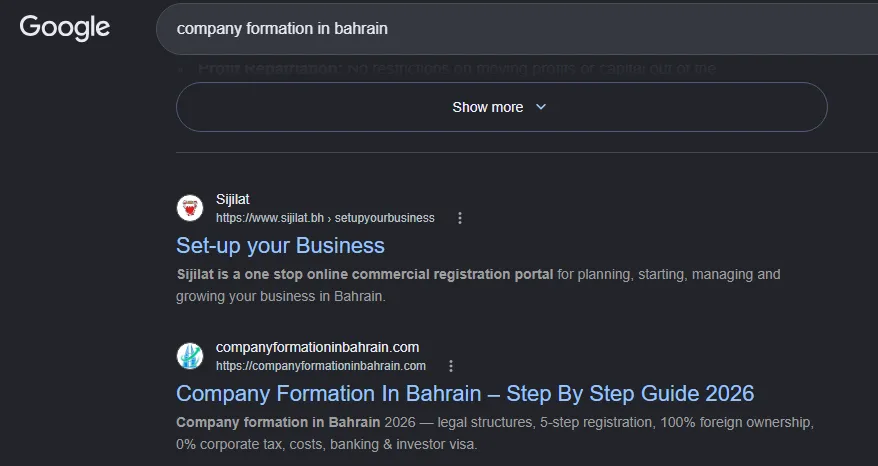
PI Startup Advisory sold company formation in Bahrain, and “company formation in bahrain” was the keyword that carried the business conversation. The first result on that SERP is the government’s own registration portal, Sijilat, so the realistic fight is for the positions immediately below it: positions 2 to 5, against agencies, law firms and established formation providers.
The main site had the service pages, but not the ranking. It sat off page one, competing against its own overlapping pages: several near-duplicate service and market pages, thin pages that existed only to hold a keyword, and internal links spread evenly rather than pointed at the commercial pages. Content was being published, but nothing told Google which page was the canonical answer for that query.
Why we decided to solve it
For a formation business the keyword is the sales channel. Ranking outside the top three means the enquiry goes to a competitor, and the reporting layer we had just built would only prove that traffic existed rather than that it converted. The target was explicit: top three on the main site, then hold page one with a second domain as the group expanded into new markets.
How we did it
Start with the keyword, not the page
Keyword research mapped the query cluster around company formation in Bahrain: cost, requirements, foreign ownership, bank account, visa, renewal. Each cluster got one owning page and a set of supporting articles. That decided which existing page would be optimised for the head term and which were duplicating it.
It was laid out as a topical map rather than a keyword list — main topic, sub-topic, one page per query — because the duplicate pages in the way of the head term were exactly what a keyword list would have produced again.
Remove what was holding the site down
Thin and overlapping pages were removed or merged, with redirects and canonical signals cleaned up behind them. This was the part with the least visible output and the largest effect: fewer competing pages meant the head term had a single, clear target.
Rebuild internal linking around the money pages
Internal links were rebuilt as a deliberate structure rather than an even spread: service pages linking to their supporting articles, articles linking back with descriptive anchors, and every market page reachable within a few clicks. Orphan pages were either connected or removed.
Write, design and publish
I briefed and managed the writers producing the supporting articles, and managed the graphics work for the pages. I designed the service, template and landing pages myself in Bricks, then published them — so the page built for the keyword was the page that shipped, not a design compromise handed off in a document.
Make the pages machine-readable
Structured data was designed as a system rather than per page: organisation, local business, service, FAQ, how-to, article and breadcrumb schema, applied consistently across the estate.
Take a third position on page one
Once the main site and the new domain were competing for the same query, I implemented parasite SEO: a LinkedIn article published through the company page, targeting the same keyword and internally supported by the other work. LinkedIn’s domain authority carried it into the results on its own.
The result
The main PI Startup site moved into the top three for company formation in Bahrain in the tracked markets.
CompanyFormationinBahrain.com, a new domain in the same group, then ranked #1 in Bahrain and in the targeted European markets, and #2 in the US, directly behind the Sijilat government portal.
With the LinkedIn article holding position 1, three of the page-one results for the keyword belonged to the company.
A note on the rankings
These are point-in-time captures from Google, and rankings move. The positions above describe what the work achieved during the engagement; that keyword is no longer managed by me, and current positions are not claimed here. Not every market was captured in a screenshot, so the US result is shown as the documented example of the second-domain position.
Evidence
What the work looked like.
Captures from the engagement. Images marked as redacted have sensitive business data blurred before publication.
Contact
Want to talk through a project like this?
I am open to remote SEO, web design and performance roles. If you need more detail on a specific project, ask — I will share what the client allows.
- [email protected]
- Phone
- +92 322 6189669
- Location
- Multan, Pakistan · Remote
- Status
- Open to remote roles