Topical mapping · Keyword research · Semantic SEO · Content architecture
FassihFayyaz.com: Topical Map for a New Site
A topical map for a site that does not exist yet — main topic, sub-topics and the individual page that owns each query, with search volume and CPC, so the build is decided by the map rather than the design.
Results at a glance
- Structure
- 4 levels
- Per row
- Keyword · volume · CPC
- Status
- In progress
- Property
- Own site
Topic to individual page
Plus build status
Site not launched
The problem
A new site starts with a decision that is hard to reverse: what it publishes first. Most small sites answer that with a keyword list, then discover months later that three articles compete for the same query, that the head terms have no realistic path, and that the site has no shape a search engine can read.
I am building a new FassihFayyaz.com from scratch, and I wanted the information architecture settled before any design or build work happened. This project is the planning layer: the map the site will be built against.
Why we decided to solve it
Content is the expensive part. A page that has to be rewritten because it duplicated another page costs more than the planning would have.
The map also fixes the order of work. With one owning page per query and the sub-topics arranged under their parent, publishing can proceed branch by branch — a hub page, then its supporting articles — instead of scattering thin pages across the whole niche and hoping the site looks coherent.
How we did it
Four levels, one page per query
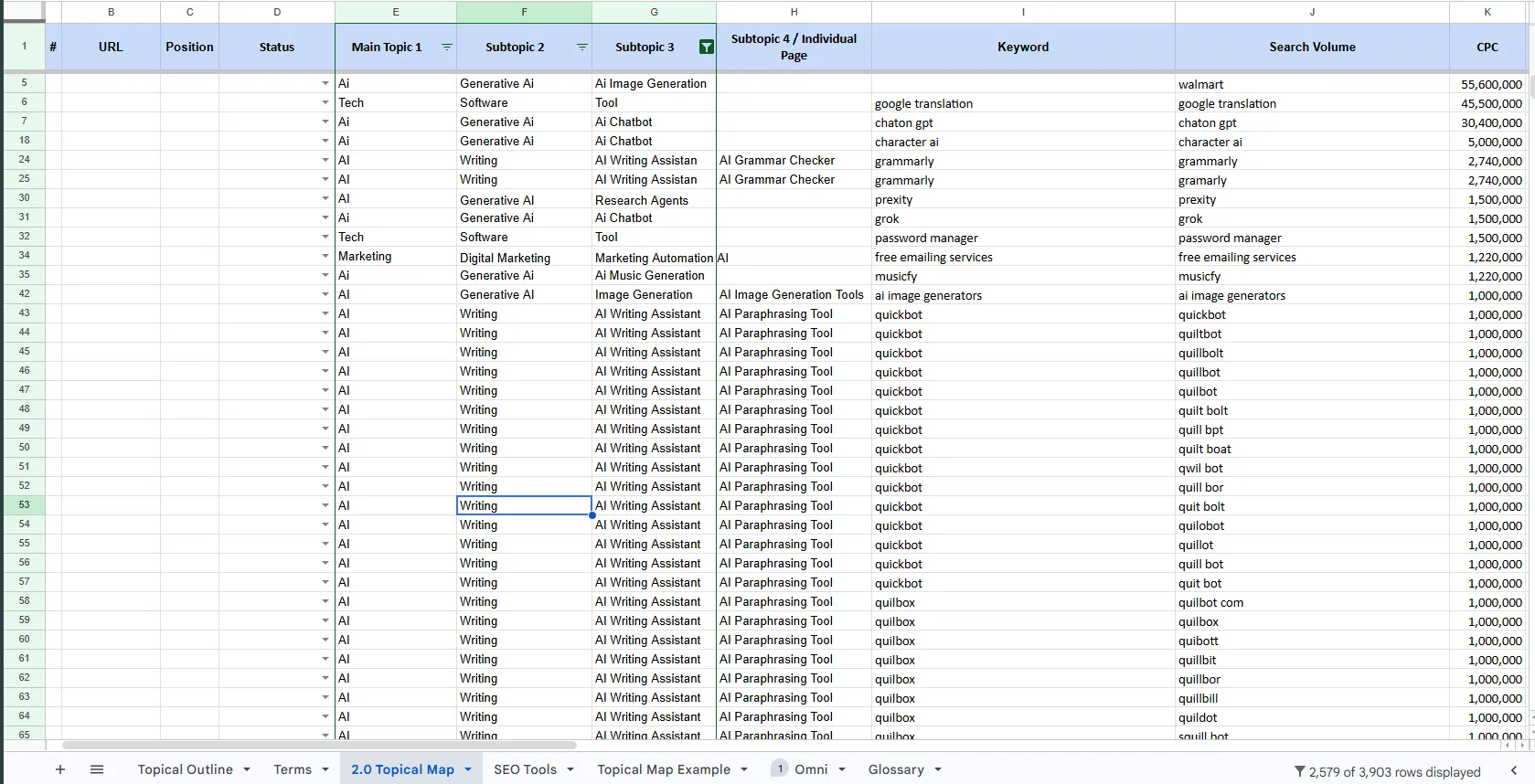
The map runs main topic → sub-topic → sub-sub-topic → the individual page, and only the last level becomes a URL. That is the rule that stops two pages being written for the same search: if two queries would produce the same page, they merge, and if they need different pages, they are separated deliberately.
Research on the row, not in a separate doc
Each row carries what the page is for: the keyword, its search volume and its CPC. Volume tells me whether the branch is worth the writing; CPC tells me whether the traffic has commercial intent behind it. Both stay visible while the structure is being decided, instead of living in a spreadsheet nobody opens again.
Track status and position in the same sheet
The map has status and position columns, so the plan and the result sit in one place. A branch that has been written, published and is ranking is visible as such, and the next piece of work is whatever is empty.
Agree the shape before the build
A mind map version is used first, to argue about branch structure without arguing about cells. Only when the branches are agreed does it become the spreadsheet, and only then does the site get designed and built around it.
The result
A complete map of the site’s intended content, with the head terms, the supporting branches and the individual pages that own them, plus the commercial signals needed to decide what is worth writing first.
The site itself is in progress, so there is no traffic or ranking outcome to report yet. What exists is the plan the build follows: a site whose structure was decided by search evidence rather than by a page list invented in a kickoff meeting.
Evidence
What the work looked like.
Captures from the engagement. Images marked as redacted have sensitive business data blurred before publication.
Contact
Want to talk through a project like this?
I am open to remote SEO, web design and performance roles. If you need more detail on a specific project, ask — I will share what the client allows.
- [email protected]
- Phone
- +92 322 6189669
- Location
- Multan, Pakistan · Remote
- Status
- Open to remote roles