Off-page SEO · Link acquisition · Digital PR
New Domain Backlink Growth: CFIB and Oman
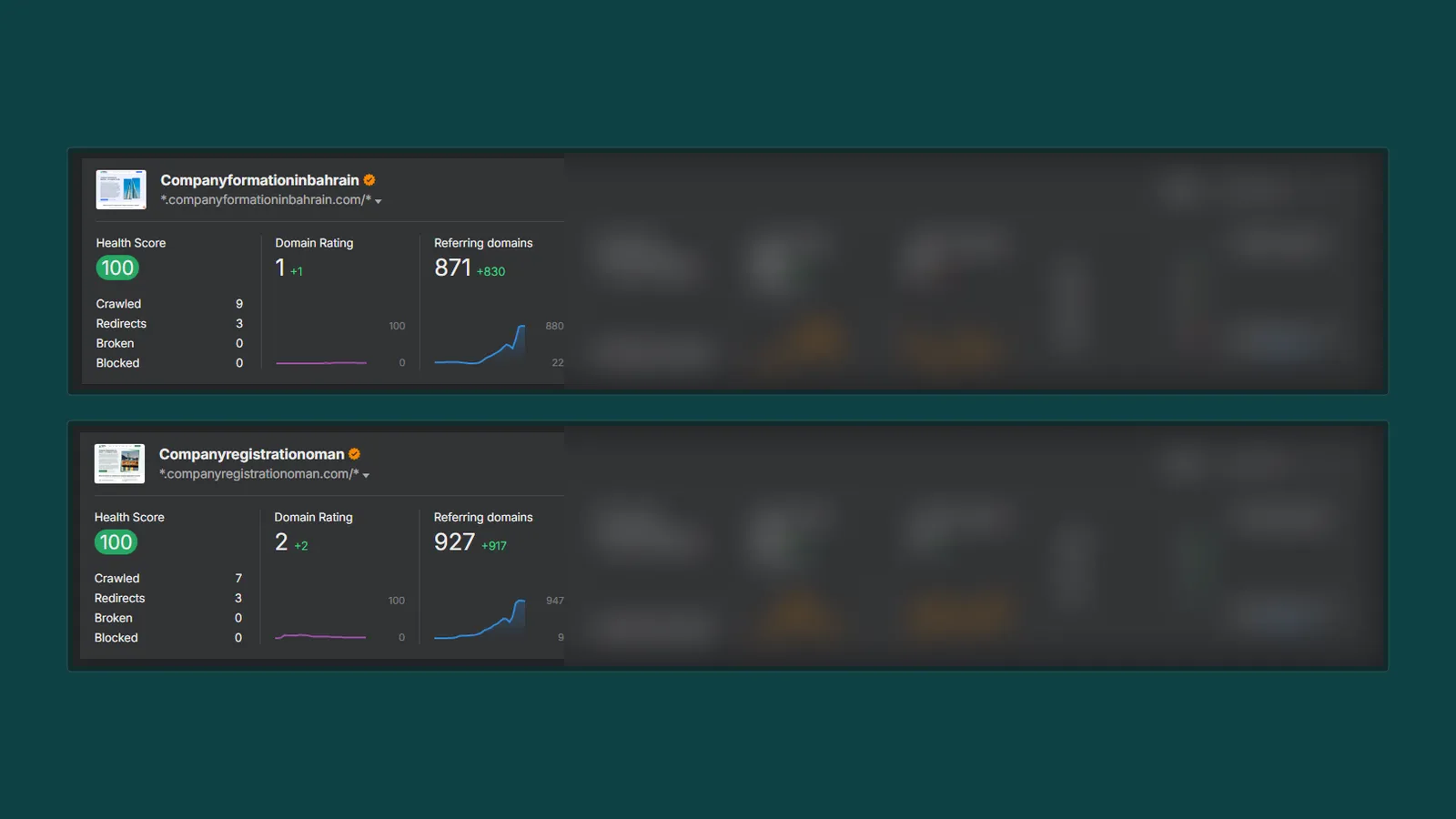
Two new company-formation domains gained +830 and +917 referring domains in the same campaign window while both maintained an Ahrefs Health Score of 100.
Results at a glance
- CFIB referring domains
- +830
- Oman referring domains
- +917
- Health score
- 100 / 100
871 total at capture
927 total at capture
Both domains
The problem
CompanyFormationinBahrain.com and CompanyRegistrationOman.com were new domains in markets where the parent brand already had an established site. They had content, but almost no referring-domain history.
A new domain can publish useful pages and still struggle to rank because search engines have little independent evidence that the site is worth trusting. The usual shortcut — buying a batch of cheap links — would have created a different problem: a profile that looked inflated, irrelevant or toxic.
Why we decided to solve it
The two domains were part of a wider market strategy. If they could not earn authority independently, every new page would depend on the parent brand and the content team would keep competing with established competitors on an uneven footing.
We wanted a link profile that could survive review: relevant sources, natural anchor variation, and a health score that stayed intact while the domains grew. That meant treating acquisition and risk monitoring as one process rather than two separate campaigns.
How we did it
Build a target model before outreach
I mapped the topics each domain needed to rank for, then identified the kinds of sites that would be relevant to those topics: business directories, local and regional publications, industry resources and practical guides. Relevance came before domain authority.
Run outreach with a reason to link
The content team produced pages that were useful to link to — process explainers, comparisons and market-entry guides. Outreach referenced the specific resource rather than asking for a generic homepage mention. That improved response rates and kept anchors natural.
Use LinkedIn Pulse for third-party assets
For priority topics where a direct link was unlikely, I published LinkedIn Pulse articles that could rank as third-party assets and route readers back to the relevant service page. This created an additional surface in search without adding low-quality links to the domains themselves.
Monitor the profile as it grew
New links were reviewed against the same risk criteria used in the disavow work on the parent site. Irrelevant or toxic patterns were documented and removed from consideration rather than allowed to accumulate.
The result
CompanyFormationinBahrain.com added +830 referring domains, reaching 871 at the time of capture. CompanyRegistrationOman.com added +917, reaching 927. Both domains held an Ahrefs Health Score of 100.
The important part was not the raw count. It was that the domains grew a relevant link profile without the toxic pattern that had required 250 domains to be disavowed on the parent estate.
The campaigns also gave the content team a repeatable acquisition model: choose a topic, build a resource worth citing, identify relevant publishers, and measure the profile as it changes.
Evidence
What the work looked like.
Captures from the engagement. Images marked as redacted have sensitive business data blurred before publication.
Contact
Want to talk through a project like this?
I am open to remote SEO, web design and performance roles. If you need more detail on a specific project, ask — I will share what the client allows.
- [email protected]
- Phone
- +92 322 6189669
- Location
- Multan, Pakistan · Remote
- Status
- Open to remote roles